Lake Como Ferry Guide: Routes, Tickets, Timetables and Day Passes
How the Lake Como public ferry actually works — the three service types, which pier to use, how day passes are priced, and the mistakes that cost day-trippers hours.
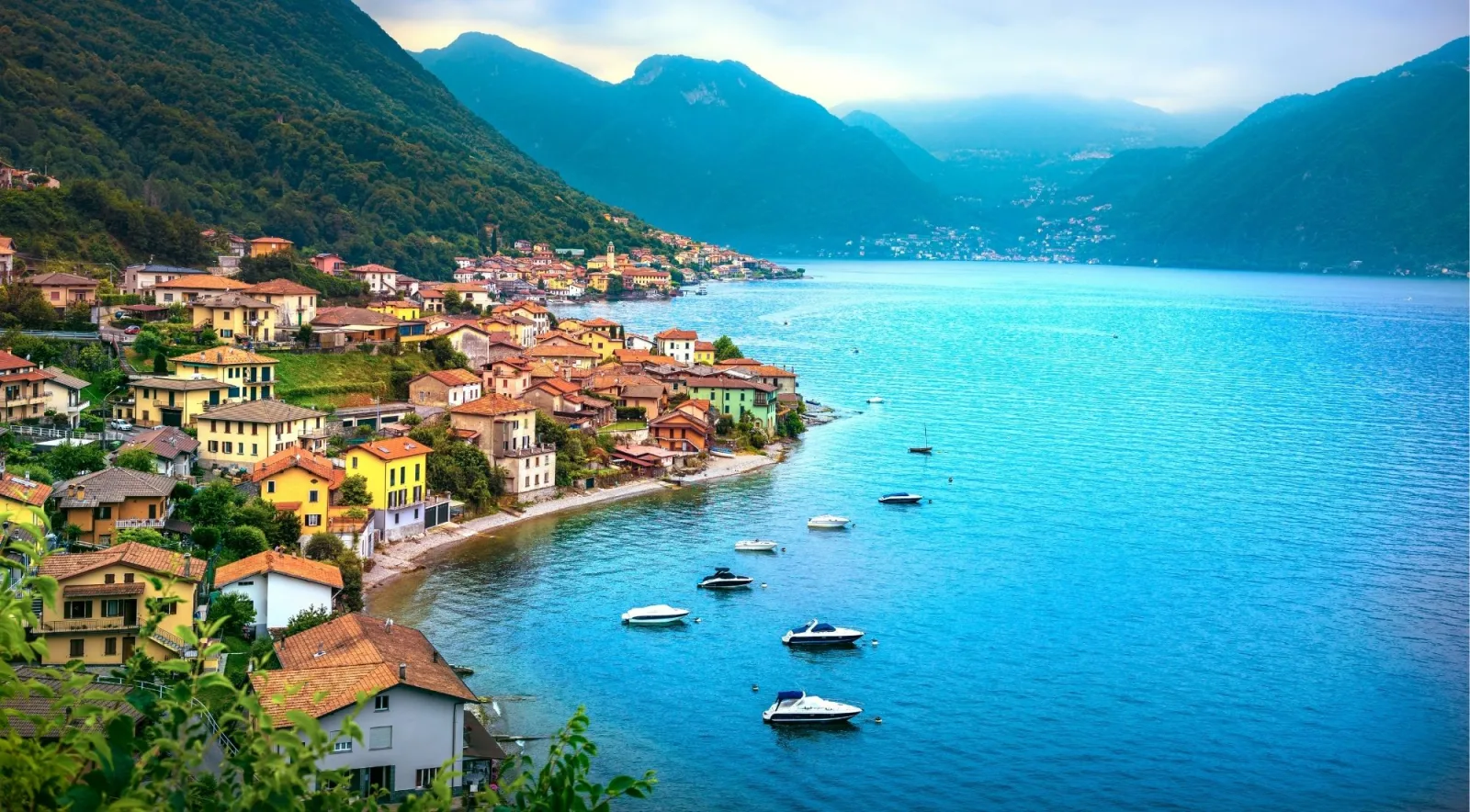
The boats are not a tourist attraction bolted onto Lake Como. They are the lake’s road network. Once you understand that — that this is a public transport system with timetables, fare stretches and a rush hour, run by a government agency rather than an excursion company — the whole lake opens up, and the day trip that looked impossible from Milan becomes straightforward.
It also explains why so many visitors get it wrong. They treat the ferry like a sightseeing cruise, board the first boat leaving Como, and discover two hours later that they have watched a great deal of shoreline and arrived in Bellagio with ninety minutes to spare before they must turn round and do it again.
This guide covers what you actually need: which of the three service types to take, which pier to stand on, whether a day pass is worth buying, and how to read a timetable that assumes you already speak Italian. If you would rather have the boats arranged for you, the most-reviewed option from Milan is the Lake Como cruise with visits to Como and Bellagio (4.7★ from 2,135 reviews), which pairs a coach from the city with a guided public-boat cruise up the Como branch — check dates below, then read on for how to do it yourself.
Who runs the Lake Como ferries?
The public boats are operated by Gestione Governativa Navigazione Laghi, a government body under Italy’s Ministry of Infrastructure and Transport that also runs the fleets on Lake Maggiore and Lake Garda. This matters for three practical reasons.
First, it is a scheduled public service, so it runs year-round in some form and prices are set by ministerial tariff rather than by demand. Second, it is entirely separate from the private boat-tour operators and water taxis you will see touting along the Como and Bellagio waterfronts — different boats, different piers in some towns, different tickets. Third, when something goes wrong, notices are published formally on the operator’s website, which is the only place worth checking on the morning of your trip.
If someone sells you a “Lake Como ferry ticket” that is not from Navigazione Laghi, you have bought a private cruise. That may well be what you want — see Lake Como boat tours compared, and the ferry-versus-boat-tour comparison further down — but it is not the same product.
The scheduled boats will get you between Como, Bellagio, Varenna and Menaggio all day, but they never slow down for the view. Guided day trips from Milan bundle the coach, the ferry crossings and a narrated cruise up the Como branch; private and small-group boat tours trace the villa shoreline past Villa del Balbianello, Villa Carlotta and Isola Comacina at water level; half-day walking tours cover Como’s Duomo and lakefront before the boats. These are the experiences travellers most often add to a ferry day:
The three types of boat, and why the difference matters
Nearly every mistake day-trippers make comes from not distinguishing these.
| Service | Italian name | What it is | Best for |
|---|---|---|---|
| Slow boat | battello / corsa ordinaria | The standard passenger ferry, calling at most piers along the route | Scenery, flexibility, short hops, day-pass holders |
| Fast service | servizio rapido / aliscafo | Hydrofoil, limited stops, supplement payable on top of the base fare | Covering distance quickly — especially Como to the central lake |
| Car ferry | traghetto | Vehicle-and-passenger shuttle across the central lake only | The Bellagio–Varenna–Menaggio–Cadenabbia crossings; the most frequent and most weather-resistant service on the lake |
The slow boat and the hydrofoil follow the same Como–Colico spine. The car ferry does something different: it shuttles back and forth across the narrow waist of the lake, roughly every forty minutes to an hour on the summer 2026 timetable and less often outside summer, and foot passengers are welcome on it. For hopping between Bellagio, Varenna and Menaggio, the car ferry is usually the fastest and most frequent option, and it is the one least likely to be cancelled in bad weather.
The single most useful fact in this guide: the crossings within the central-lake triangle take a quarter of an hour or so. The slow boat from Como town all the way up to Bellagio takes around two hours. Same lake, wildly different propositions. Plan around this.
Which route do you actually need?
Lake Como is shaped like an inverted Y, with three arms: the Como branch running southwest, the Lecco branch running southeast, and the northern arm up to Colico. Service is concentrated where the visitors are — the Como branch and the central triangle where the three arms meet.
The Como branch (Como to Bellagio and beyond)
Boats leave Como from the pier on Piazza Cavour, in the centre of town on the lakefront, and work north along the shore, calling at villages including Cernobbio, Moltrasio, Torno, Argegno, Lezzeno, Nesso, Sala Comacina, Lenno, Tremezzo and Cadenabbia before reaching Bellagio, Varenna and Menaggio. Some services continue north to Bellano, Dongo, Gravedona, Piona and Colico.
This is the beautiful route and the slow one. The full Como–Colico run is a substantial voyage, not an errand. If your goal is to see the western shore — the villas, the gardens, the villages stacked up the hillsides — take the slow boat and enjoy it. If your goal is to arrive somewhere, take the hydrofoil or reconsider your starting point entirely.
The central triangle (Bellagio, Varenna, Menaggio, Cadenabbia)
This is where a Lake Como day trip earns its reputation. Three of the lake’s best towns sit within a short crossing of each other, connected by both passenger boats and the car ferry running all day. You can breakfast in Varenna, walk Bellagio’s stepped alleys before lunch, and be looking at Menaggio’s waterfront by mid-afternoon without ever waiting long for a boat.
Coming from Milan, the efficient way to reach this triangle is not via Como town at all — it is the direct train to Varenna-Esino and a short crossing from there. This is covered in full in how to get from Milan to Lake Como, and it is the single biggest time saving available to a day-tripper.
The Lecco branch and the northern lake
Services run from Bellagio down the Lecco arm, and up the northern arm to Colico, but at much lower frequency than the Como branch. Both are worth exploring if you have several days. Neither belongs in a one-day itinerary from Milan.
Beyond the ferry: other ways onto the water
Which pier? The mistake that strands people
At Bellagio, Varenna, Menaggio and Cadenabbia there are two separate piers: the passenger-boat pier and the car-ferry pier, which the operator lists distinctly as Bellagio (Traghetto), Varenna (Traghetto), Menaggio (Traghetto) and Cadenabbia (Traghetto).
They are not always adjacent. At Varenna in particular, arriving at the wrong one with a train to catch is a genuinely bad twenty minutes. Before you set off for the pier, check which service your next boat is — passenger or car ferry — and follow the signage for that one specifically. If in doubt, ask for the traghetto by name; the word is understood everywhere on the lake.
Bellagio also has a second stop, San Giovanni, a little south of the main village pier. Not all services call there. Check the pier name printed on your ticket against the pier you are standing on.
Tickets: what to buy, and how the fares are built
Fares are set by a ministerial tariff and revised periodically — the current Lake Como tariff took effect on 1 April 2026. Rather than named zones, the system prices each journey by fare stretch, so the cost rises with distance in steps. Children in the four-to-eleven band travel at roughly half the adult fare, under-fours generally travel free, and there are provisions for disabled passengers and their companions.
Because the tariff is revised without much notice, this guide gives price tiers rather than figures. Check the current tariff on the operator’s official rates page before you travel.
Single and return tickets
The default. A single ticket covers one journey between two named piers, on ordinary services. Return tickets on the same route are straightforward, but note the general rule that a simple return does not entitle you to break your journey at intermediate stops — if you want to hop off along the way, you need one of the products below.
Circular tickets
A useful and under-publicised option. A circular ticket (biglietto circolare) is issued between two piers on ordinary services and explicitly entitles you to make intermediate stops, expiring only when you return to the pier where it was issued. The operator currently publishes circular fares for routes including Como–Urio, Como–Nesso and Lecco–Onno.
If your plan is “potter up the western shore, get off wherever looks good, come back”, this is the product designed for you.
Day passes (libera circolazione)
The libera circolazione pass gives unlimited travel within a defined geographic area for the day, and there are several versions covering different stretches — a compact Como-area pass, a wider Como–Varenna pass, and central-lake options. Read the area covered before buying, because a pass sold for one stretch of the lake is worthless on another.
Critically: day passes cover ordinary services only. If you want to use the hydrofoil, you must buy the rapid-service supplement separately at a ticket office ashore. Turning up at a fast-service gate with only a day pass will not work.
Is a pass worth it? Rough rule: a day pass tends to pay for itself somewhere around the third or fourth separate journey. A day-tripper doing Varenna → Bellagio → Menaggio → Varenna is close to the break-even point. Someone doing a single out-and-back to Bellagio is better off with a return or an excursion ticket. If you are going to spend the day genuinely hopping, buy the pass and stop thinking about it — the freedom to catch the next boat on a whim is most of the value.
Excursion and combined tickets
The operator sells packaged excursion tickets on popular day-trip routes — including a Como–Bellagio excursion and a longer Como–Bellano–Bellagio version — priced as a bundle for adults and children in the four-to-eleven band. These are simple and worth comparing against a day pass if you know exactly where you are going.
Separately, Trenitalia sells a combined train-and-boat product: buy a rail ticket to Como San Giovanni and you can add a discounted Navigazione Laghi day pass, usable within a few days of the rail journey. The scheme runs to 30 September 2026 and excludes Trenord-operated services, which is an important catch given how many Milan–Como trains are Trenord. Trenord runs its own separate train-plus-boat lake day-trip products; details in how to get from Milan to Lake Como.
There are also standing concessions for Touring Club Italiano and Automobile Club Italiano members, and family and local-resident schemes. Worth two minutes at the ticket window if any apply to you.
Where and how to buy tickets
Buy at the ticket office at the pier where possible. Larger piers — Como, Bellagio, Varenna, Menaggio — have staffed offices, and this is also where you buy hydrofoil supplements and ask the questions that save you an hour later.
You can buy online through the operator’s official site, and the operator has also introduced NaviTap, a contactless-card system for travelling without a paper ticket.
Three rules that trip people up:
- Fast-service tickets must be bought before boarding, from a ticket office ashore — not from the crew.
- Buying on board when a ticket office is open attracts a surcharge. If the office is shut, buying on board is normal and no penalty applies.
- Carry the ticket until you are off the boat. Inspections happen.
In July and August, the queue at Como’s Piazza Cavour ticket office at mid-morning is real and slow-moving. If you are on a tight day-trip schedule, buy tickets for the whole day in one transaction at your first stop, or buy online the night before.
Timetables: how to read them without losing an afternoon
The operator publishes seasonal timetables as PDFs, split by route. For summer 2026 the timetables run 1 July to 4 October 2026; the preceding spring timetable ran from 23 March, extended to 30 June. Winter timetables are considerably thinner.
There are separate PDFs for:
- Como – Colico – Como (ships and fast service on the main spine)
- Bellagio – Lecco – Bellagio (the Lecco branch)
- Bellagio – Cadenabbia – Varenna – Menaggio, published as two separate documents — one for weekdays, one for Sundays and public holidays
That last point catches people out constantly. Italian timetables distinguish feriale (working days, including Saturdays) from festivo (Sundays and public holidays), and the two schedules are genuinely different. If you are visiting on a Sunday or an Italian public holiday, you need the festivo column. Reading a Saturday timetable on a Sunday is how people miss last boats.
Other conventions worth knowing: services are numbered, and notices about disruption refer to those numbers rather than to times, so it is worth noting the number of your intended boat. Footnote symbols against individual departures usually indicate seasonal or day-specific restrictions — if a departure has a symbol, find the key before relying on it.
Practical approach: download the PDF for your specific route and date range, find your outbound departure and, before you leave, write down the last two return departures. Not the last one. The last two.
When things go wrong
Strikes (scioperi) are announced in advance and a guaranteed minimum service is normally maintained, typically including a morning and an afternoon departure on the main routes. Notices appear on the operator’s avvisi page.
Weather cancellations happen, most often to the fast hydrofoil service, which is the first thing suspended when the lake gets rough. The car ferry is the most resilient service on the lake.
Water levels and works. The operator’s notices are worth a genuine look rather than a glance. In August 2026, for example, a load limitation was imposed on the car ferries because of low water levels, and individual service suspensions have been published through the season. These are exactly the sort of thing that does not appear in guidebooks or on aggregator sites.
Check the avvisi page the morning you travel. It takes thirty seconds and it is the difference between adapting and being stranded.
Ferry or private boat tour — which should a day-tripper take?
They solve different problems, and plenty of people should do both.
| Public ferry | Private or shared boat tour | |
|---|---|---|
| Cost | Low, fixed by tariff | Substantially higher |
| Flexibility | Go where you like, when you like | Fixed route and duration |
| Coverage | Every significant town, all day | Scenic circuits, villa shorelines, hidden coves |
| Views | Good, from a large boat | Excellent, low to the water, close to the shore |
| Commentary | None | Usually included |
| Best for | Getting between towns | The hour on the water you will actually remember |
The pattern that works best on a single day from Milan: use the public ferry as transport, and add one short private or shared boat tour for the experience of being out on the lake in a small boat. The villa-shoreline circuits — the ones that pass Villa del Balbianello and the Comacina island — see angles no scheduled ferry route offers.
Our picks on GetYourGuide: for a small-boat circuit that includes the coach from Milan, the Lake Como private boat tour with Como and Bellagio (4.3★ from 373 reviews) has the guide pointing out Villa del Balbianello and the celebrity villas from the water on the way to Bellagio — see our full breakdown of the private boat tour. If you would rather do the classic slow-boat run with a guide and skip the ticket queue, the Lake Como cruise with visits to Como and Bellagio (4.7★ from 2,135 reviews) is the most-booked version — read our breakdown before you choose.
Frequently asked questions
How long does the ferry take from Como to Bellagio?
Around two hours on the slow boat, which calls at numerous villages along the way, and under an hour on the fast hydrofoil. If reaching Bellagio quickly is the priority, take the hydrofoil — or approach the central lake from Varenna instead, where the crossing takes minutes rather than hours. You can compare every Como to Bellagio option, the C130 bus included.
Do I need to book Lake Como ferry tickets in advance?
No. Ordinary services are turn-up-and-go, and tickets are sold at pier offices on the day. Booking ahead online mainly saves you queueing at Como in high summer. Fast-service tickets must be purchased before boarding, but not necessarily days ahead.
Is the Lake Como ferry day pass worth buying?
It generally becomes worthwhile from around the third or fourth journey. If you are hopping between Varenna, Bellagio and Menaggio, it usually pays. For a single return to Bellagio, a return or excursion ticket is cheaper. Check which geographic area the pass covers before buying, and remember it does not include the hydrofoil supplement.
Can I take a car on the Lake Como ferry?
Yes, on the traghetto car ferry across the central lake between Bellagio, Varenna, Menaggio and Cadenabbia. It is not available on the Como branch. That said, driving is rarely the right choice for a day trip — see the parking and ZTL warnings in how to get from Milan to Lake Como.
Do the ferries run in winter?
Yes, but on a much reduced timetable, with fewer departures, some piers unserved and the fast service scaled back. A winter day trip is entirely feasible if you build the plan around the timetable rather than the other way round. See the best time to visit Lake Como.
Which pier does the ferry to Bellagio leave from in Como?
Piazza Cavour, on the lakefront in the centre of Como. It is roughly ten to fifteen minutes on foot from Como San Giovanni station, and only a few minutes from Como Nord Lago station.
Are the ferries wheelchair accessible?
The larger modern vessels and the car ferries are generally accessible, and the operator maintains a dedicated accessibility page covering assistance for passengers with reduced mobility. Some smaller village piers involve steps or steep gangways depending on water level. If access matters, contact the operator’s freephone line before travelling to confirm your specific piers.
Before you go: the two-minute check
- Download the correct seasonal timetable PDF for your route — and the festivo version if you are travelling on a Sunday or public holiday.
- Check the operator’s notices page for suspensions, strikes and works.
- Write down the last two return departures, not just the last one.
- Confirm the current tariff on the official rates page — fares are revised by ministerial decree and this guide deliberately does not quote figures that will age.
- Identify which pier your boat leaves from, passenger or traghetto.
Fares, timetables and service patterns on Lake Como change seasonally and are revised without extended notice. Everything above was checked against Gestione Governativa Navigazione Laghi’s official Lake Como pages in September 2026. Always verify with the operator before booking or building a tight itinerary around a departure.
Planning the rest of the day? Start with how to get from Milan to Lake Como to pick the right train, decide between the two star villages in Bellagio vs Varenna, and check the best time to visit Lake Como before you fix a date. If you’d rather not touch a timetable at all, compare every guided Lake Como day trip from Milan.
See Lake Como Without the Stress
Join thousands of travellers who booked a guided day trip from Milan — ferries, boat rides, and free time in Bellagio and Como, all arranged for you. Free cancellation.
Check Availability & Book